Boeing will replace Mike Sinnett as vice president and chief project engineer for the 787 program with his counterpart on the 777, Bob Whittington, as part of a major management shuffle within the company’s engineering ranks, the company announced last Friday. Sinnett—the 787’s lead engineer since January 2010—will assume the role of vice president of product development in place of Larry Schneider, who assumes Whittington’s position as v-p and chief project engineer on the 777. The moves account for part of an effort to reorganize Boeing Commercial Airplanes’ engineering department into three independent but cooperative design centers based in Washington State, Southern California and South Carolina, according to BCA vice president of engineering Mike Delaney.
http://ainonline.com/aviation-news/2013-07-29/sinnett-leave-787-program-boeing-shuffles-engineering-roles
In anticipation of Tropical Storm Flossie heading for Hawaii, some airlines have cancelled flights that were to arrive in the Aloha State today.
Alaska Airlines has cancelled its flights due to arrive in Hawaii through noon on Monday, July 29, 2013. The carrier also has instituted a flexible rebooking policy for Monday, July 29, and Tuesday, July 30, that allows most Hawaii passengers to make one change to their itineraries without the standard change fee. The policy, which includes some restrictions, covers passengers flying to or from Hawaii's Honolulu, Lihue, Kahului/Maui, and Kona airports. United Airlines has also cancelled flights that were scheduled for Hawaii.
Listed below are the flights that are cancelled for 7/29/30 as of 8:00 am HST.
Kona
Alaska Flight 843/806 SEA/KOA/SEA
Alaska Flight 825/826 OAK/KOA/OAK
Kahului, Maui
Alaska Flight 841 OAK/OGG
Alaska Flight 862 OGG/PDX
Alaska Flight 820/831 SMF/OGG/SMF
Alaska Flight 847 SAN/OGG
Alaska Flight 889/812 SJC/OGG/SJC
Alaska Flight 863/866 SEA/OGG/SEA
Honolulu
Alaska Flight 833/834 PDX/HNL/PDX
Alaska Flight 837/838 SJC/HNL/SJC
Alaska Flight 827/S36 OAK/HNL/OAK
Alaska Flight 851/880 SEA/HNL/SEA
Alaska Flight 895/892 SAN/HNL/SAN
American Flight 283/270 LAX/HNL/LAX
American Flight 123/8 DFW/HNL/DFW
American Flight 31/162 LAX/HNL/LAX
United Flight 707/769 DEN/HNL/DEN
United Flight 1226 LAX/HNL
United Flight 145 IAD/HNL
United Flight 73 SFO/HNL
United Flight 1228 LAX/HNL
United Flight 1230/1233 LAX/HNL/LAX
United Flight 560/235 SFO/HNL/SFO
United Flight 1030/1227 LAX/HNL/LAX
United Flight 172/154 MAJ/HNL/MAJ
United Flight 200 GUM/HNL
United Flight 200 HNL/IAH
United Flight 14 HNL/EWR
WestJet Flight 1864/1865 YVR/HNL/YVR
Lihue
Alaska Flight 855/850 SAN/LIH/SAN
Alaska Flight 881/848 SJC/LIH/SJC
Alaska Flight 875/854 SEA/LIH/SEA
http://www.eturbonews.com/36590/airlines-cancel-flights-headed-hawaii?utm_source=feedburner&utm_medium=feed&utm_campaign=Feed%3A+Eturbonews-TravelAndTourismIndustryNews+%28eTurboNews+-+for+the+global+travel+professional%29
Philippine Airlines (PR, Manila) will, effective August 1, transfer the following Manila-based domestic routes to subsidiary, PAL Express (2P, Manila): Bacolod (5 daily), Iloilo (5 daily), Laoag (10 weekly), Tagbilaran (3 daily). Three out of ten weekly flights to General Santos will also be transferred. As a result, from August 1, Philippine Airlines' domestic network will consist of only Manila to Cebu (81 weekly frequencies), Davao (52 weekly) and Kalibo (5 weekly) according to Airlineroute.
http://www.ch-aviation.ch/portal/news/20740-philippine-airlines-to-move-some-manila-domestic-routes-to-pal-express
Delta Air Lines will debut increased domestic service beginning this fall at Los Angeles International Airport with new daily flights to four destinations and expanded service to nine existing markets.
Delta currently operates more than 115 peak-day departures to 40 destinations from Los Angeles, and every flight offers BusinessElite/First Class and Economy Comfort seating. Additionally, every domestic flight features Wi-Fi service.
Delta’s new and expanded Los Angeles service includes (effective dates):
Pacific Northwest service with four new daily flights to Portland, Ore.*, as well as two additional daily flights to Seattle* (Sept. 3)
Expanded Bay Area service with three additional daily flights to San Francisco*, two additional daily flights to Oakland, Calif.*, and one additional daily flight to San Jose, Calif.*, (Sept. 3)
One additional daily flight to New Orleans (Sept. 3)
One additional daily flight to Kansas City, Mo.* (Sept. 3)
Additional flights to both Indianapolis and Columbus, Ohio resulting in daily service (Sept. 3)
Retimed daily service to Tampa, Fla., and Raleigh, N.C. (Sept. 3)
New limited daily service to Missoula, Mont.*, and Kalispell, Mont.* (Dec. 21 – Jan. 5)
New limited daily (Dec. 21 – Jan. 5) and Saturday only (Jan. 11 – March 29) service to Jackson Hole, Wyo.*
Seasonal limited daily (Dec. 21 – Jan. 5) and Saturday only (Jan. 11 – March 29) service to Bozeman, Mont.* (Dec. 21 – March 29)
*A portion of travel for some itineraries may be on the Delta Connection® carriers: Compass Airlines and SkyWest.
“Delta is committed to being the preferred airline for our customers in Los Angeles by providing additional service at more convenient times and during key demand periods,” said Bob Cortelyou, Delta’s senior vice president – Network Planning. “Coupled with our expanding airline partnerships and improved airport customer experience, we offer a superior product in one of the industry’s most competitive markets.”
http://www.breakingtravelnews.com/news/article/delta-adds-new-and-enhanced-service-at-los-angeles/
A Qantas plane grounded on an Auckland Airport runway today has now been removed.
Spokesman Simon Lambourne said the Qantas aircraft experienced a problem with its brakes as it was taxiing off a runway after its arrival from Sydney.
"The aircraft stopped on the taxiway but for safety reasons we closed part of the runway until such time as the plane could be removed," he said.
Accordingly, the runway has now been fully reopened.
Some redirected flights diverted to Christchurch, Ohakea and Wellington airports are now returning to Auckland.
However, Mr Lambourne said that there will be delays and possibly some cancellations as a result of the partial closure earlier today.
Passengers can check Auckland Airport's flight arrival and departure information here.
http://tvnz.co.nz/national-news/auckland-airport-reopens-after-qantas-plane-breakdown-5522678
 The thin plastic skin on Boeing’s 787 Dreamliner is an engineering marvel, a mix of carbon fibers and epoxy molded into large barrel-shaped sections that are then baked at up to 350 degrees in giant ovens.
But while airlines love how this lightweight concoction saves fuel, the recent fire on a 787 at Heathrow Airport in London provides the first test of how difficult and costly it will be to repair serious damage. It’s happening at a pivotal moment for Boeing, which is eager to show that even significant damage to a carbon-composite plane like the 787 can be repaired as quickly and effectively as in the old aluminum models. Each day a jet remains grounded costs an airline tens of thousands of dollars.
Investigators say they believe that the cause of the fire, a pinched wire on an emergency transmitter, was fairly mundane. But the damage was anything but. The high temperatures weakened the supports in a 10-foot stretch at the top of the rear fuselage and seared the paint on the top of the skin, causing the most extensive damage yet to one of the new Dreamliners.
Aviation experts say Boeing will cut out the damaged areas and glue or, probably, bolt a large patch, made of overlapping panels of composite materials, onto the shiny new plane, which is less than a year old. “That’s a little like ‘Phantom of the Opera,’ where the guy had this mask to cover the fact that half his face was missing,” said Hans W. Weber, an aviation consultant in San Diego.
Boeing will also need to install new composite supports, and possibly some made of stronger titanium, to hold that mask in place and shore up the structural integrity of the plane, owned by Ethiopian Airlines. If the damage were more extreme, the plane maker could remove the entire 23-foot-long barrel containing most of the jet’s rear fuselage and snap in another one, though composite experts doubt that it will do so in this case.
Boeing said it was presenting the repair options to the airline and would not discuss them publicly. Its engineers are running computer models to analyze the costs and other trade-offs, like how much the added weight from the bracing might reduce the plane’s heralded fuel savings.
Boeing executives say they have been developing the repair techniques for years, as they gradually increased the use of composite parts in other planes. And many of them are similar to the methods used with aluminum.
“We feel comfortable that we know how to address this issue and most other structural issues as they arise,” Boeing’s chief executive, W. James McNerney Jr., said last week.
But some analysts seemed more skeptical, saying the fire on the Ethiopian jet raised a wild card that could make the repairs much more complicated than others on the 70 Dreamliners delivered since late 2011. Boeing said it had made smaller composite repairs on a few 787s that had been hit by lightning or bumped by airport service vehicles or mechanics’ tools.
Given how crucial the innovative jets are to Boeing’s future — it expects to sell thousands of them in the coming decades — “they will do anything at this point to show that that airplane is repairable,” said Robert Mann, an aviation consultant in Port Washington, N.Y. “We’ll know how long it takes them to fix it, but realistically, we may never know what it costs.”
The use of composite materials started on military jets and has grown steadily on commercial planes over the last several decades. Only 1 percent of the weight of Boeing’s 747 jumbo jet came from composite parts when that jet was introduced in 1969. That increased to 11 percent by 1995 on the 777, which has an all-composite tail section. Airbus, the European plane maker, has followed the same trend, using composites on the wings and upper fuselage of the double-decker A380.
Composites now account for half of the 787’s weight, which, together with more efficient engines, cut fuel consumption by 20 percent. The 787’s future rival, the A350, also has a composite fuselage.
Boeing and its suppliers build the 787’s fuselage out of long strands of carbon fiber coated with an epoxy resin. Resembling black masking tape, the strands are layered around a rotating mold by a computer-controlled robot that looks like a spider spinning a barrel-shaped web. The fuselage is built in several sections at plants in Japan, Italy and the United States, where the deafening sounds of metallic clanging have been replaced by the electrical whir of robots and automated systems.
http://www.nytimes.com/2013/07/30/business/boeings-787-poses-new-challenges-for-repair-teams.html?partner=rss&emc=rss&_r=0
On Thursday, officials with the Florida Division of Emergency Management received an anonymous call indicating that there were storage containers at Opa Locka Airport that containeduranium (U-235).
HazMat crews closed down the airport and identified the location of the uranium. The uranium was tested and considered to be depleted uranium (DU), a lower content of the fissile isotope U-235 than natural uranium. Natural uranium is about 99.27% U-238, 0.72% U-235—the fissile isotope, and 0.0055% U-234).
Uses of DU take advantage of its very high density. Civilian uses include counterweights in aircraft, radiation shielding in medical radiation therapy and industrial radiography equipment and containers used to transport radioactive materials. Military uses include defensive armor plating and armor piercing projectiles. Most depleted uranium arises as a byproduct of the production of enriched uranium for use in nuclear reactors.
It was learned that an old airplane, most likely B-727 had been dismantled and a number of its parts containing uranium were placed in two 55 gallon drums and placed on a wooden pallet. A spokes person with Florida’s Division of Emergency Management said the aircraft dates back to a time when uranium was being used for navigational purposes.
Arnold Piedrahita, Miami-Dade Fire Rescue said “Depleted uranium is used in the fabrication of counterbalance weights. It’s a common practice. However, this material must be disposed of properly. It cannot be discarded as it was in this case.” Miami-Dade Emergency Management cordoned off a 150 foot radius. They reported minimal radiation had been released and there were no injuries.
http://avstop.com/july_2013/authorities_locate_depleted_uranium_at_opa_locka_airport.htm
UPS released its annual Sustainability Report announcing that while the total number of packages shipped in 2012 increased, the company reduced its total Greenhouse Gas (GHG) emissions. Environmental achievements included ground and air fuel savings, increased investments in alternative fuel vehicles, and retooled routes that shaved 12.1 million miles from ground deliveries.
"UPS also set a new alternative fuel goal," said David Abney, UPS Chief Operating Officer. "By 2017, the company will reach one billion miles driven by alternative fuel/advanced technology vehicles - more than double the previous 400 million mile goal."
For the second year in a row, UPS earned superior credentials for reporting transparency a Sustainability Report that fulfills the Global Reporting Initiative's requirements for an A+ level as well as third party assurance of its report and greenhouse gas data from Deloitte & Touche. Less than 20% of all GRI Sustainability Reports are A+.
"Our industry-leading accomplishments showcase innovative technology and global operational efficiency gains as well as world-class credentials for rock-solid data," said Scott Wicker, UPS Chief Sustainability Officer. "The report's theme, More of What Matters, sharpens UPS's focus on how to make the most measurable positive impact through sustainability business practices and logistics expertise."
In 2012 UPS Airlines, which represents 57 percent of UPS's carbon footprint, reduced its fuel use and carbon production. Air shipping volume rose 4.8 percent year over year, while fuel use dropped 1.3 percent.
One of the cornerstones of UPS's environmental strategy is to support the development and use of lower-emission alternative fuels. Vehicles represent approximately 35 percent of UPS's carbon footprint. UPS is accelerating its testing, purchase and deployment of new-generation vehicles. Between 2000 and the end of 2012, the alternative fuel/advanced technology fleet has logged 295 million miles with an ambitious new goal of 1 billion miles set for 2017. In 2012, this growing fleet drove 49 million miles, a 43 percent increase compared to 2011.
Earlier this year, UPS announced plans to add nearly 1,000 liquefied natural gas (LNG) tractors in the next two years, expanding its current fleet of 2,700 alternative fuel and technologically advanced vehicles. The fleet today includes all-electric, electric hybrids, hydraulic hybrids, natural gas (LNG, compressed natural gas), propane, biomethane, and light-weight fuel-saving composite body vehicles.
The new Sustainability Report also cites the greenhouse gas reductions, fuel savings and miles avoided through the innovative use of technology. For example, telematics data fed through vehicle sensors helped UPS cut more than 206 million minutes of engine idling time last year, saving more than 1.5 million gallons of fuel. Routing technology increased pickup and delivery stops per mile, saving 12.1 million miles of driving which equates to approximately 1.3 million gallons of fuel.
http://avstop.com/july_2013/ups_reports_reduction_of_total_greenhouse_gas_emissions.htm
Etihad Airways is looking to increase its stake in Virgin Australia, after winning Australian government approval to almost double its Virgin shareholding from 10 percent to 19.9 percent.
The Gulf carrier and cornerstone Virgin Australia partner has neither confirmed nor denied it's behind a $7m parcel of Virgin Australia shares which changed hands earlier this week.
However Etihad CEO James Hogan admitted the airline was "buying on the market at the moment".
Read: We're in for long haul says Etihad chief as he lifts stake in Virgin (The Australian)
Etihad currently sits third on the roster of airlines with a stake in Virgin Australia, behind Air New Zealand's 22.99 percent. and Singapore Airlines' 19.9 percent.
SQ upped its share from 10 percent last month in a deal worth $122.6 million, having purchased the holding from Sir Richard Branson's Virgin Group.
Etihad has been busy weaving its own bespoke alliance of airlines through financial stakes, with knock-on effects for Virgin Australia as Virgin CEO John Borghetti builds out his own 'virtual network'.
Earlier this week Virgin Australia announced a partnership with German carrier airberlin, which is 29.21 percent owned by Etihad.
http://www.ausbt.com.au/etihad-ponies-up-for-larger-stake-in-virgin-australia

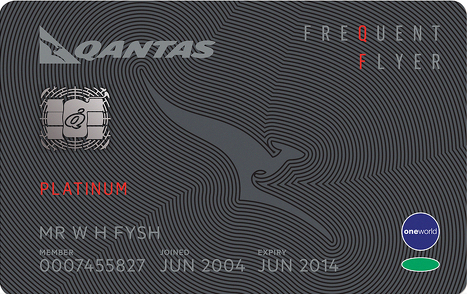
 Qantas will release the first of its new-look Frequent Flyer cards in the coming months, and we've got a sneak peek at the shiny new plastic.
The cards incorporate the slick new Qantas Frequent Flyer brand – note how the Q and F are called out to echo the airline's flight code.
Qantas will release the first of its new-look Frequent Flyer cards in the coming months, and we've got a sneak peek at the shiny new plastic.
The cards incorporate the slick new Qantas Frequent Flyer brand – note how the Q and F are called out to echo the airline's flight code.
(If you're wondering who the high-flying Mr W. H. Fysh is – that's Sir Wilmot Hudson Fysh, born in Launceston in 1895 and one of the founders of Qantas in 1920, after Fysh served in Australia's Royal Flying Corps during World War I.)
There's also a more stylised approach to the iconic flying kangaroo logo, which incorporates a series of expanding curved lines reminiscent of Aboriginal artwork.
Of course, each card includes the smartchip for Qantas' streamlined checkin – even the entry-level Bronze card, which has previously not been blessed with this time-saving technology.
Members of the elite Qantas Chairman's Lounge will get a card with a slightly different design.
Activated on an opt-in basis, this prepaid card contains 'virtual wallets' for up to nine currencies – including the Aussie dollar – which can be used for shopping in Australia and overseas, as well as online.
The Qantas Cash card also permits cash withdrawals from ATMs internationally and within Australia, and supports tap-and-go PayPass technology.
The first batch of the new Qantas cards are due to reach frequent flyers in September as part of the Qantas Cash rollout.
http://www.ausbt.com.au/new-look-qantas-frequent-flyer-cards-on-the-way